Two tropical cyclones generally represent two independent weather systems and move independently of each other. But in case the cyclones come very close to each other, their circulation system can start interacting in multiple ways.
- The track of cyclones may curve
- One cyclone may start orbiting other
- The weaker cyclone may be absorbed by the stronger one.
- This type of interaction between two cyclones is termed as Fujiwhara Effect.
Due to these complex interactions and the resultant changes in track, intensity or speed, the cyclone forecasting becomes difficult.
Why was it in the news?
In September 2025, Hurricane Humberto and Tropical Storm Imelda developed simultaneously over the western Atlantic. Forecast models initially indicated that the two systems might come close enough to undergo a Fujiwhara-type interaction.
The possibility was particularly significant because Humberto was the much larger and stronger system. Its circulation had the potential to alter Imelda’s track and possibly draw it away from the south-eastern coast of the United States.
What is Fujiwhara Effect?
The Fujiwhara Effect is the mutual interaction between two nearby cyclonic vortices in which they begin to rotate around a common centre and influence each other’s movement.
NOAA defines it simply as the tendency of two nearby tropical cyclones to rotate cyclonically about each other.
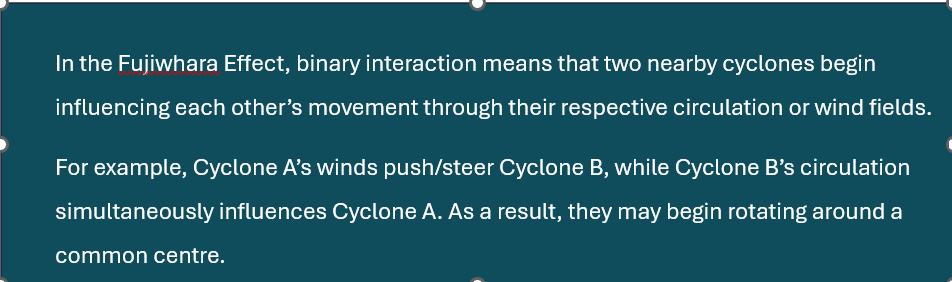
It is therefore also called a binary cyclone interaction, meaning an interaction between two cyclones in which each influences the movement of the other.
How does the Fujiwhara Effect work?
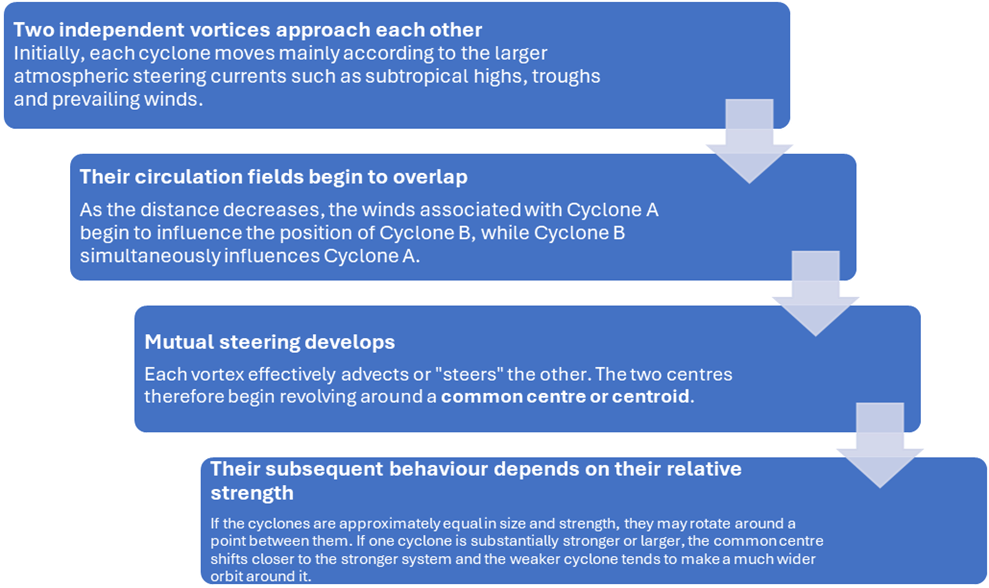
A tropical cyclone is essentially a large rotating vortex of air around a low-pressure centre. Its circulation extends hundreds of kilometres beyond the eye.
When another cyclone enters this circulation, each cyclone begins to experience the wind field generated by the other.
In which direction do they rotate?
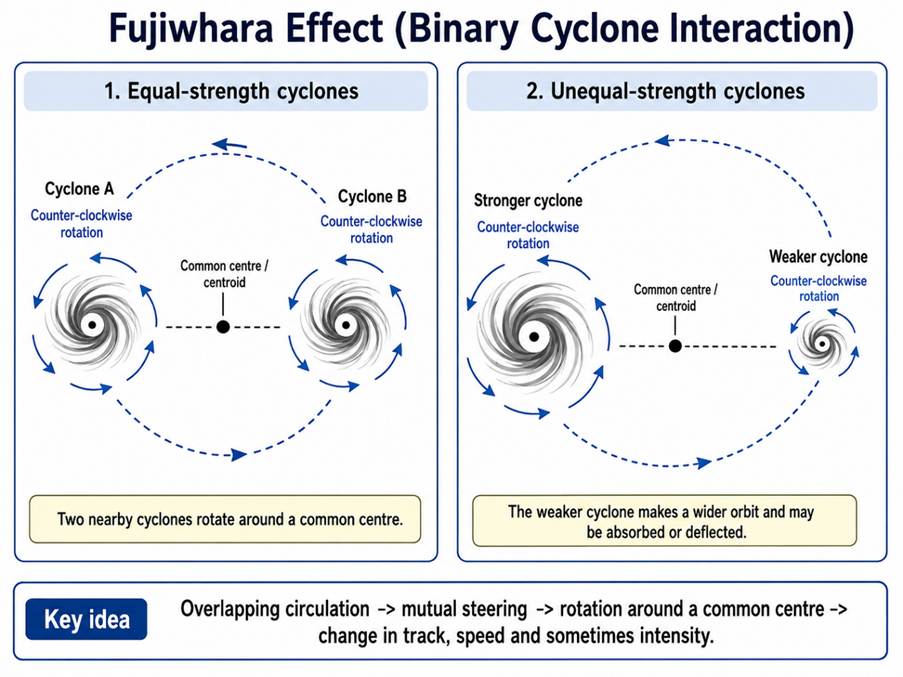
The pair rotates in the same cyclonic sense as the individual storms:
- Northern Hemisphere: counter-clockwise
- Southern Hemisphere: clockwise
Thus, the interaction of two cyclones should not be visualised as two objects physically colliding. They behave more like interacting vortices in a fluid.
What can happen to the two cyclones?
| Outcome | What happens? | Possible consequence |
| Mutual orbiting | Cyclones rotate around a common centre | Both tracks become curved or looped |
| Deflection | Interaction alters their original trajectories | One or both storms may move towards or away from land |
| Absorption | A stronger/larger vortex dominates the weaker one | Weaker cyclone loses its independent circulation |
| Merger | Two vortices eventually combine into one circulation | A single larger system emerges |
| Separation | After temporary interaction, environmental steering currents pull them apart | Both continue on different tracks |
Important example:
Humberto and Imelda, 2025 — North Atlantic
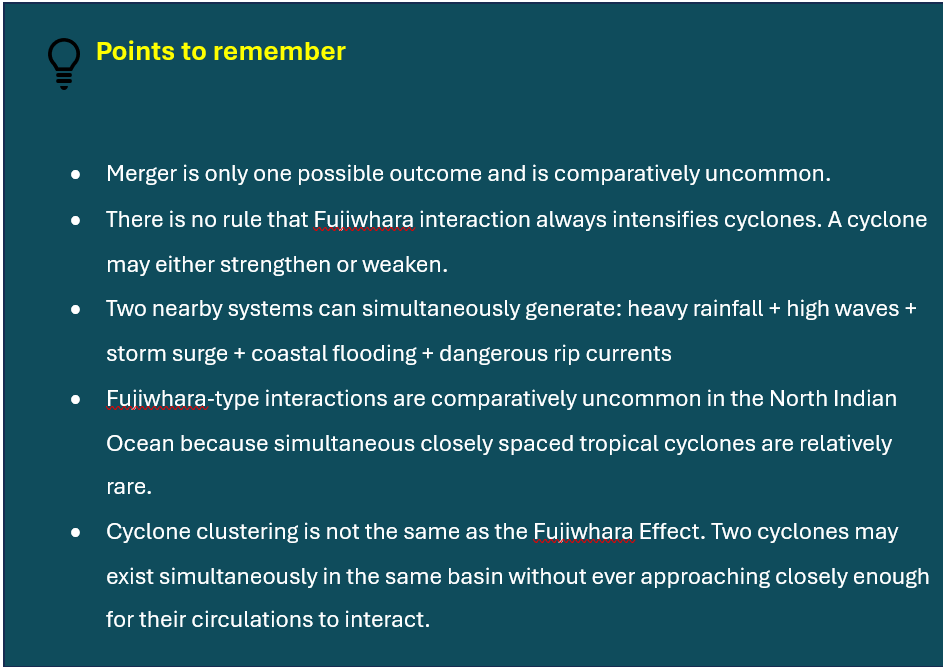
Their proximity created the possibility of binary interaction and complicated forecasts for the US East Coast. Humberto’s circulation and its effect on the subtropical ridge contributed to Imelda ultimately remaining